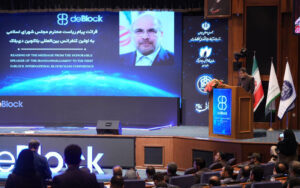
In the Name of God
Distinguished guests, dear participants, and esteemed hosts of the deBlock International Conference,
The digital world and the digital economy represent the inevitable future of all nations. This transformation has created countless opportunities for growth, innovation, and global interaction. In Iran, the Seventh Development Plan Law has set an ambitious target of achieving a ten percent share for the digital economy in the Gross Domestic Product. Within this context, blockchain and crypto-assets, as one of the central pillars of the digital economy, is recognized not only as a driver of future financial transactions but also as a new asset class with unique capabilities.
Regulation of blockchain technology and digital assets, without a broad vision and macro-level strategy, can lead to market instability, capital flight, and weakened innovation. Therefore, developing a national roadmap for the advancement of crypto-assets is an undeniable necessity. This roadmap must include policies and laws that not only protect domestic businesses against foreign competitors and underground markets, but also lay the groundwork for the sustainable growth of this industry. The risks of isolated, sectoral decision-making also require coordinated policymaking among the government, the parliament, and other key institutions; only through coordinated and integrated cooperation can the capacities of this technology be harnessed to achieve national objectives.
On the other hand, we are witnessing a global economy moving toward multipolarity, and international cooperation within frameworks such as BRICS has created strategic opportunities for nations. For the Islamic Republic of Iran, this framework can serve as a tool for diversifying methods of financial exchange and reducing dependence on the traditional financial system. The use of shared cryptocurrencies within bilateral or multilateral monetary arrangements—particularly in BRICS-Plus interactions—can help strengthen economic independence and facilitate international trade. In this path, the Islamic Consultative Assembly has a key role to play in providing the legal groundwork for the adoption and utilization of modern financial systems. By looking to global crypto-asset standards as a tool for strengthening economic independence, the Islamic Republic of Iran can become a successful model in the region and the world, and may even come to be recognized as a regional hub for crypto-assets.
However, the approach to crypto-assets should not be limited merely to mining or buying and selling. To fully harness the potential of this industry, we need the comprehensive development of a financial ecosystem based on crypto-assets. This development includes legislative support for secure and lawful exchange platforms, the applicability of crypto-assets in international financing and trade, and the tokenization of real-world assets (RWA) such as real estate, artworks, securities, and commodities. The tokenization of real assets can revolutionize financial markets and expand access to capital for broader segments of society.
Therefore, regulation in crypto-assets must be approached with an innovation-oriented mindset. Recognizing this necessity, the Islamic Consultative Assembly declares its readiness to engage with scientific elites, entrepreneurs, and the academic community in drafting forward-looking legislation, and calls on all stakeholders to play an active role, through genuine participation, in designing legal frameworks aligned with global developments.
It must be noted, of course, that achieving the aforementioned goals is not possible without the cooperation and practical action of executive bodies. Accordingly, relevant institutions—including the Ministry of Economic Affairs and Finance, the Securities and Exchange Organization, and the National Center for Cyberspace—are expected to seriously engage with crypto-assets and provide the necessary groundwork for attracting investment and ensuring market transparency. The Ministry of Industry, Mine and Trade can also play a vital role in facilitating foreign trade through the use of crypto-assets and cryptocurrencies. Likewise, the Central Bank of the Islamic Republic of Iran can take a significant step toward strengthening the country’s financial system by designing diverse national and regional cryptocurrencies for transactions with aligned nations and trading partners.
In conclusion, it can be said that crypto-assets and blockchain technology are not merely an opportunity, but a necessity for the future of both Iran’s economy and the global economy. Through the development of a national roadmap, the strengthening of international cooperation within the BRICS framework, and innovative regulation, we can confidently and successfully navigate this path. I hope this international conference will provide an opportunity for the exchange of views and synergy among experts and policymakers. I wish every success to the organizers and participants of this valuable event.
Mohammad Bagher Ghalibaf
Speaker of the Islamic Consultative Assembly
November 6, 2025